
Hello! I'm Rei, an official Notion ambassador.
Suddenly, do any of you have something you'd like to make a habit?
Since I started managing my habits with Notion, I've gotten a little better at habit formation.
This time, I'll be introducing how to manage habits with Notion!
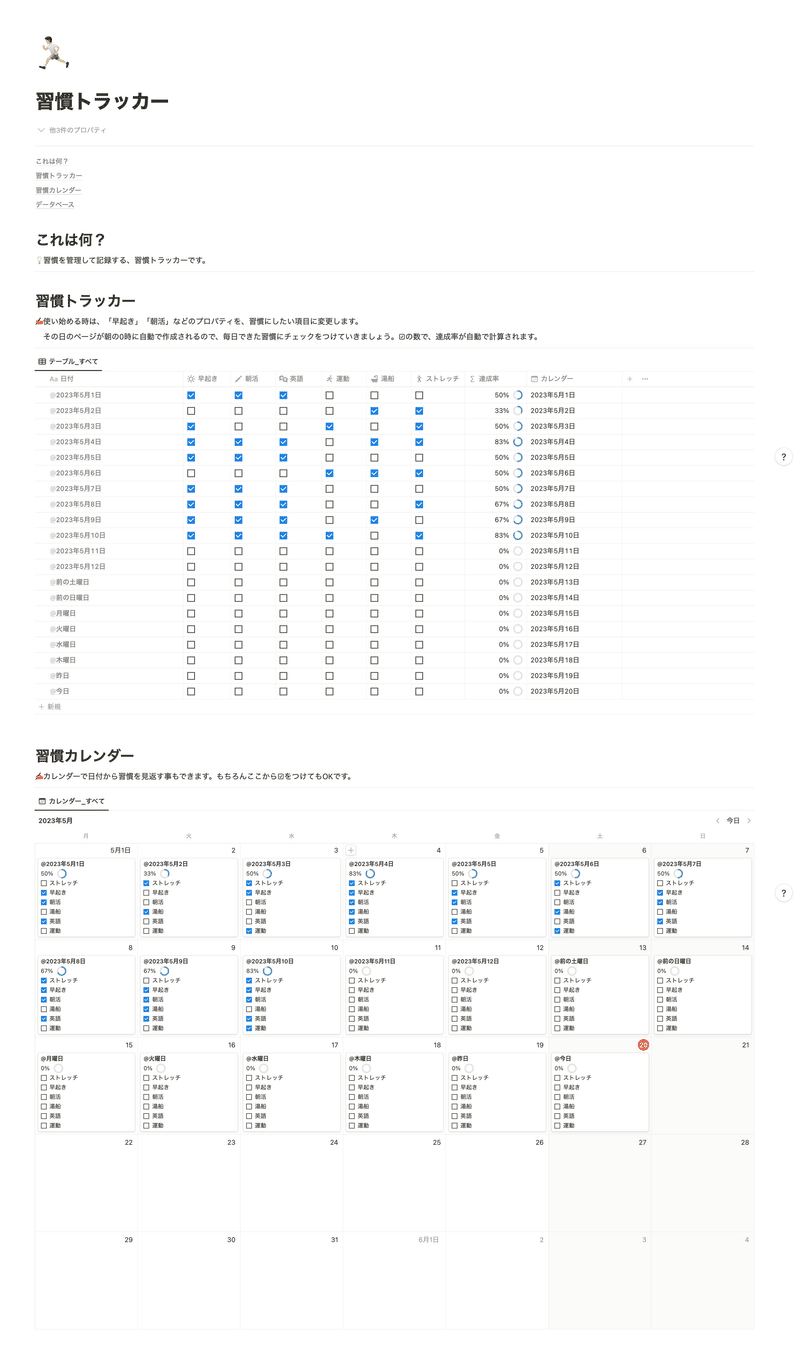
This is a recommended way to use Notion for those who want to establish habits like morning routines or strength training but struggle to stick with them, or for those who find habit-forming apps hard to maintain.
This time, I will explain this template in detail, so please read until the end!
🎬 Director:Rei
✍🏻 Writer:Minokurumi
Why create a habit tracker in Notion.
A habit tracker is a tool that helps you decide on habits you want to form and encourages you to continue them daily. You can also review whether you've maintained your habits at the end.
Before using a habit tracker, I often found it difficult to stick with habits I wanted to form.
For example, if I wanted to make strength training a habit and decided to do it every morning after waking up, I often couldn't maintain it if it was just a mental decision.
So, I tried several apps specializing in habit formation, but for someone like me who wants to minimize the number of apps, the fact that it added one more app to use and that I had to open it specifically for habit tracking just didn't suit me.
Also, since reflections could only be done within that specific app, I had some concerns like, "What if the app disappears?" or "I might not be able to look back on it years from now."
That's when I wondered if I could manage my habits in Notion, which I trust the most and use daily for my diary, so I created a habit tracker.
This has suited me very well, and I'm utilizing it by combining it with my diary and other things.
📍
2. Provides a sense of accomplishment and encourages continuation
3. Makes reviewing easy
How to manage habits with Notion.
Now, I will explain the detailed contents and how to use the habit tracker that we are distributing this time.
1. Decide what habits you want to form
First, let's start by creating a habit tracker.
What kind of things do you want to make a habit? From morning routines and language study to strength training and stretching, there are probably various items you want to make a habit.
First, decide what you want to make a habit and create your own habit tracker.
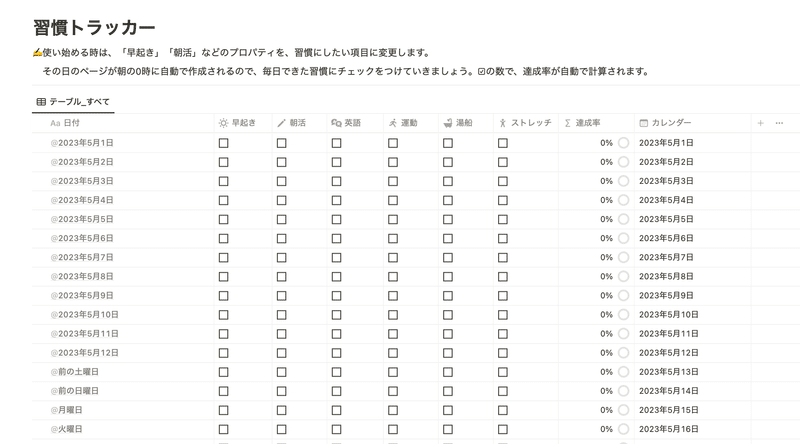
Once you've decided on the items you want to make habits, you'll revise the properties of the "Habit Tracker" template.
You can change the name by clicking on the title of the property, so try changing it to your preferred item.
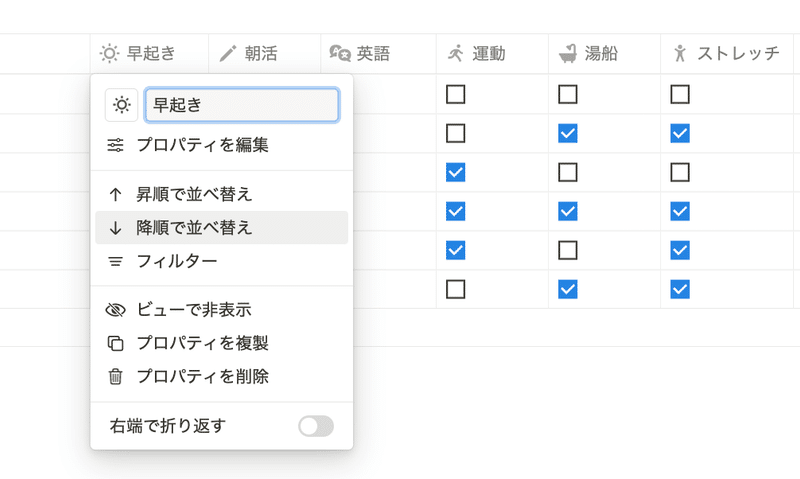
Here's a tip to make your habit tracker more fun and easier to understand: try changing the icon for each property to one you like!
Wouldn't it be easier to understand at a glance and lift your spirits a bit if the icons matched the items?
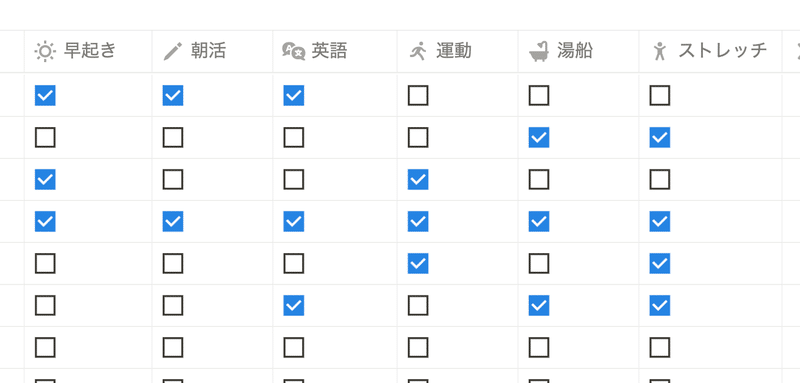
To change it, simply click on the icon to the left of the property title when you're renaming it, and choose your favorite emoji. Give it a try!
2. Record your habits
Once your habit tracker is ready, let's start working on your habits and recording them!
The template automatically creates a page for the current day at 0:00, so review and check off your habits at the end of the day or the next morning.
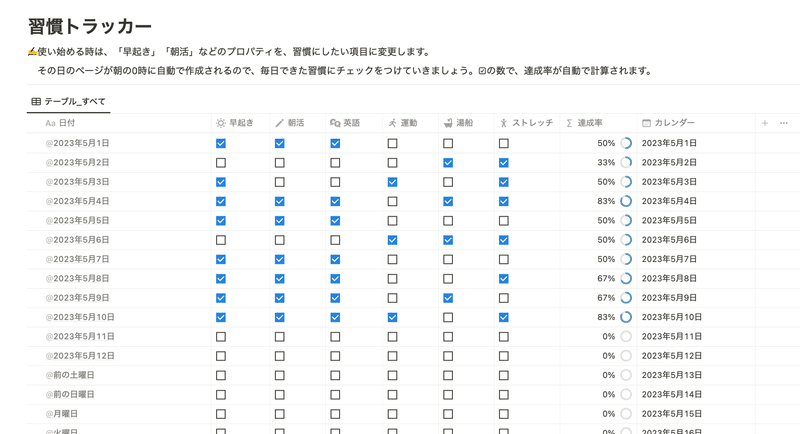
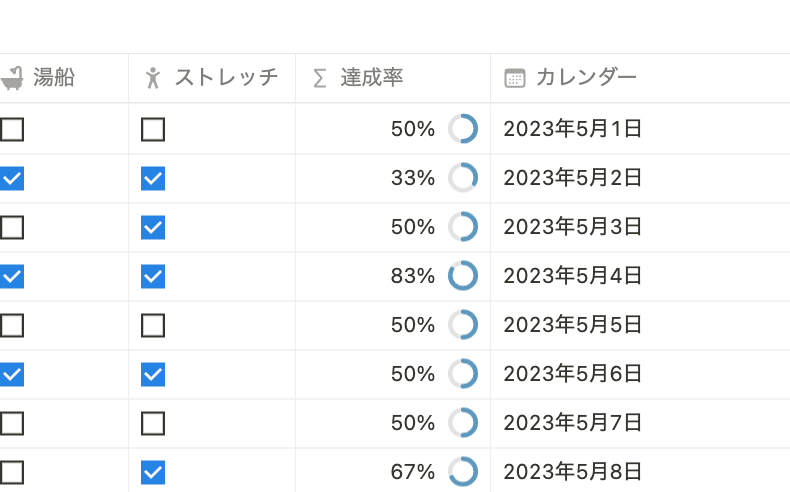
I've also set it up so that the completion rate and graph are automatically displayed based on the number of checks. This makes it easy to see at a glance how much of your habits you've completed that day.
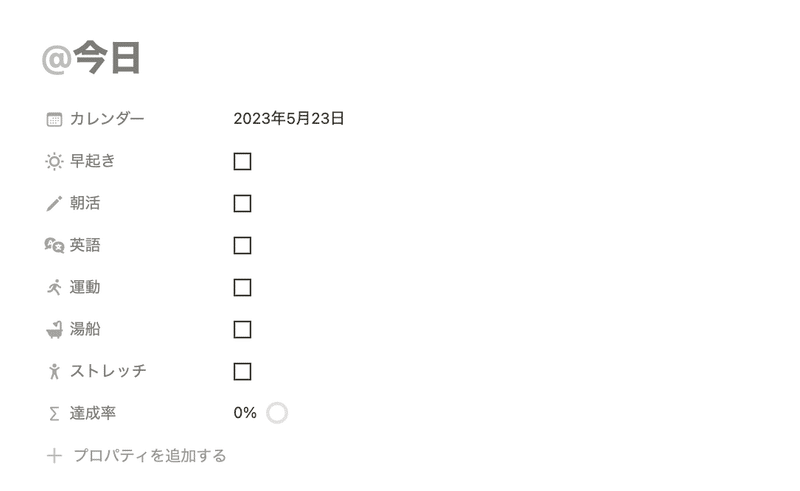
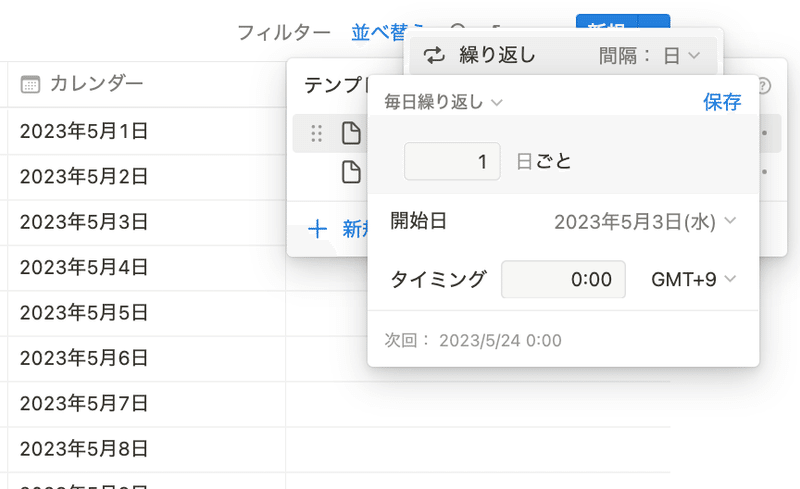
By the way, the method for automatically creating a page for the current day utilizes "templates" and "recurring tasks."
To automatically set the current date as the title in recurring tasks, enter "@today" in the template's title. After saving the template, set that template to repeat "every day" at "0:00" as a recurring task, and the template page will be automatically created at that time.
This can also be applied to diaries and other things, so please give it a try!
3. Review the month with the calendar
After the month ends, let's review the month using the "Habit Calendar."
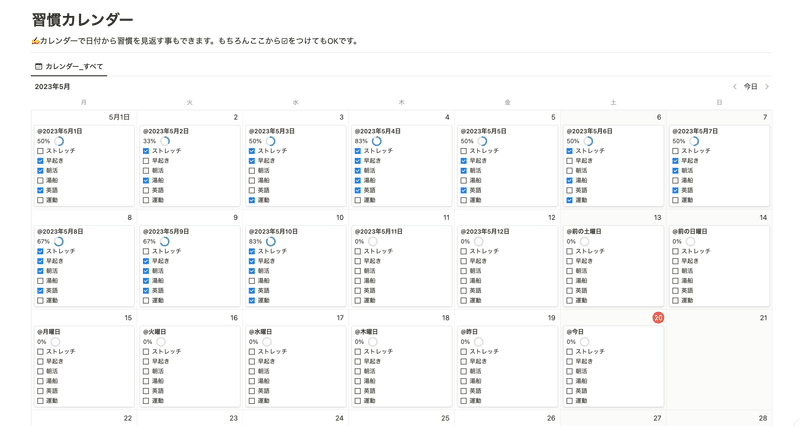
The habit tracker and calendar are linked, so checks and completion rates are automatically reflected in this calendar. Of course, you can also mark them here.
When you review it comprehensively like this, it seems easy to distinguish between the habits you've formed and those you haven't!
What's convenient about using Notion.
Finally, let's recap the benefits of managing habits with Notion.
1. Can be placed where you see it daily, or added to existing pages
As I mentioned at the beginning, habit-forming apps that required me to open them solely for habit tracking didn't suit me, and I couldn't stick with them.
With Notion, you can use "linked databases" (displaying a database in multiple locations) to place it on your daily homepage or other places you frequently visit.
Also, if you already have a database that you check daily, such as a diary, you can add checkboxes to it. I write my diary in Notion, so recently I've been adding habit checkboxes directly into my diary.
This way, you won't "forget to open it in the first place" and can consistently continue every day. This might be one mechanism for habit formation.
2. Provides a sense of accomplishment and encourages continuation
As the checkboxes fill up with checks, a sense of accomplishment gradually emerges. Visualizing the days you've completed gives you a feeling of having continued, which also makes it seem less likely to give up.
Also, the desire to "get more checks!" can be a motivator, and conversely, if there are gaps, it can make you think, "I need to do it."
3. Makes reviewing easy
If you can place it where you see it daily, reviewing also becomes easier.
You can review your habits while looking back at your diary, and even when checking off daily tasks, a calendar view makes it easy to review.
If you have a habit that you're struggling to maintain, thinking about "how can I make it work" can help you devise a system for consistency.
Summary
That concludes the introduction to how to manage habits with Notion! How was it?
I hope Notion can help you stick to your habits.
Notion's ultimate task management template, "Todotion," is available here!

The complete 2-hour "Notion Master Course" for learning Notion from scratch is now available!

The book "Notion Lifehacks," which introduces 36 ways to use Notion, is also on sale!