
Hello! I'm Rei, an official Notion ambassador.
But first, do you keep a household budget?
Believe it or not, I'm pretty messy, and I've never been able to stick to a household budget. (Tears)
This time, I'll introduce you to how I use Notion to keep a household budget that even a messy person like me can stick to.
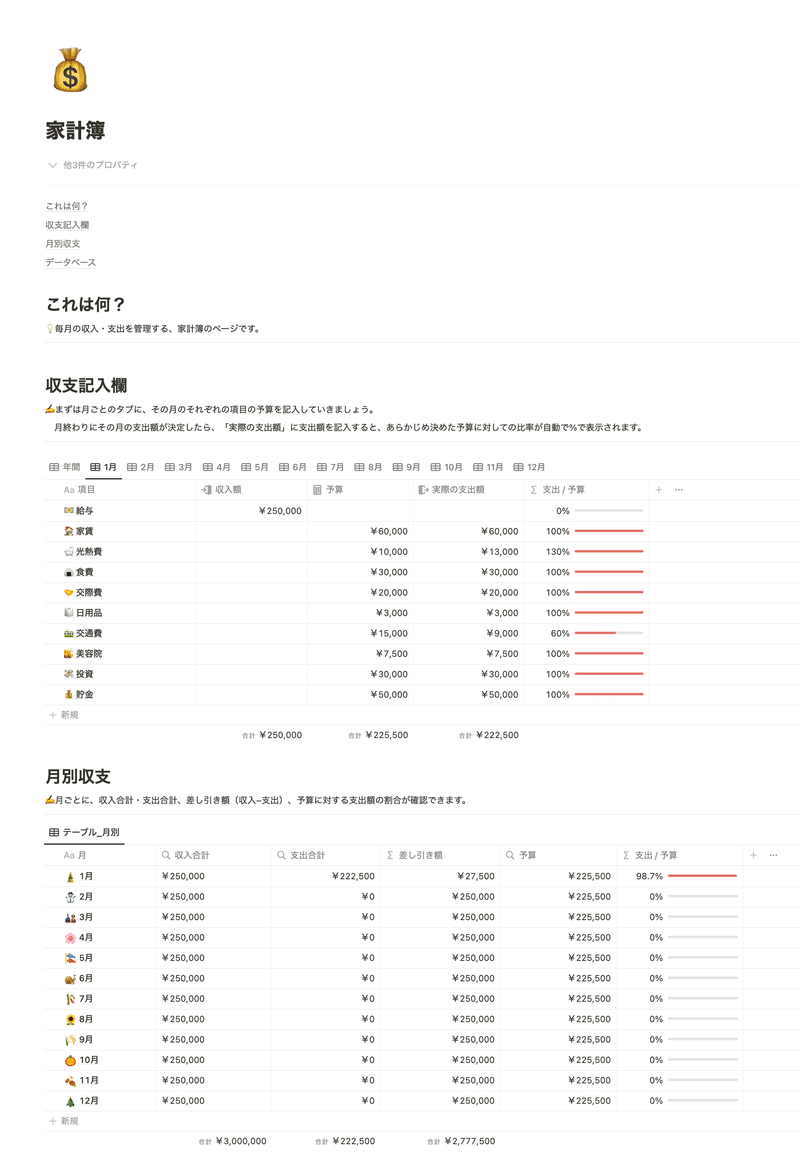
This is a recommended way to use Notion for those who "couldn't stick to a paper or app-based household budget" or "want to manage their money but find it difficult."
I will explain this template in detail, so please read until the end!
🎬 Director:Rei
✍🏻 Writer:Minokurumi
Why I created a household budget in Notion.
As I wrote in the previous article, [ How I reduced unnecessary spending by organizing my subscriptions in Notion. ], I'm actually pretty messy and bad at managing my money.
Of course, I couldn't stick to the old-fashioned paper household budget where I had to keep receipts and calculate and write everything down myself.
Even household budget apps where you just take a picture of the receipt – at first, I thought they were "revolutionary...!" but soon I got tired of even taking pictures of receipts....
I wondered if there was a way to manage my household budget without recording each individual transaction, and that's how I came up with the household budget page and the method for keeping a household budget that I'm introducing today.
If you're like me and can't seem to stick to a household budget, I highly recommend trying the method I'm introducing this time!
I'll explain in more detail why Notion is recommended for household budgeting later on.
📍
2. Calculations are completed automatically!
3. You can create and customize your own categories!
How to keep a household budget with Notion.
Now, I'll introduce the detailed contents and how to use the household budget page I'm distributing.
1. Set a budget for each spending category.
Do you know how much money you spend on what each month?
Before you start keeping a household budget, let's first decide on your monthly budget for each category at the beginning of the month.
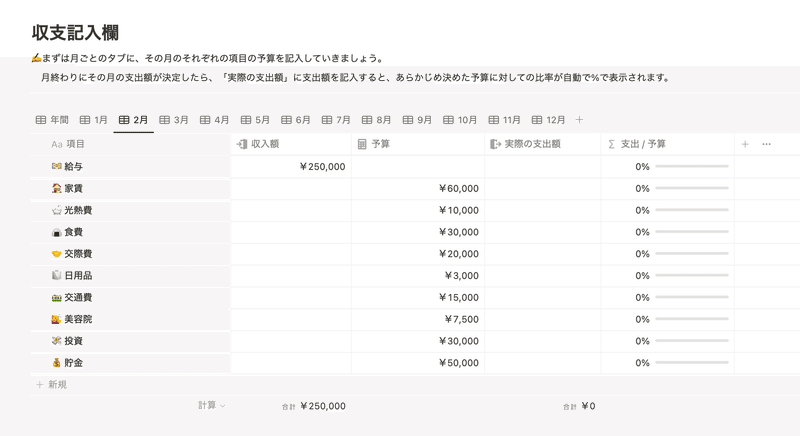
The categories are examples of typical ones, so feel free to change them to your liking or add new ones.
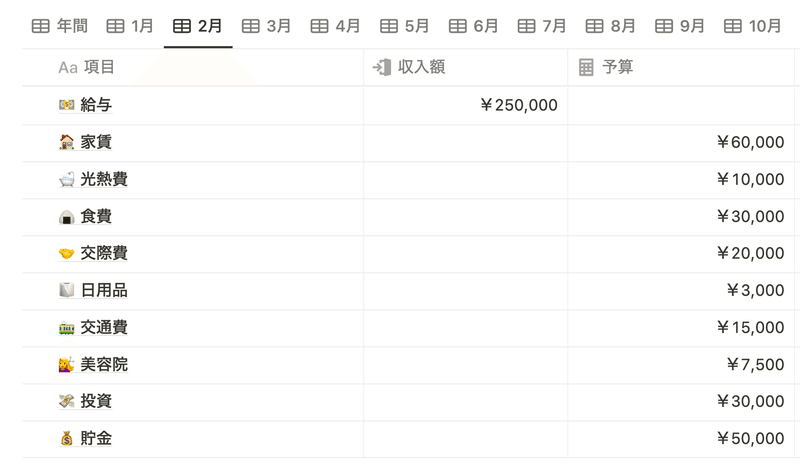
The reason for setting a budget is that by thinking beforehand about how much money you can spend on what relative to your income, you can spend the month in "saving mode," thinking, "I need to save a bit on this item."
The amount could be quite different from simply spending money without thinking about it.
2. At the end of the month, record your actual expenses.
Once the month is over, let's go ahead and record your actual expenses!
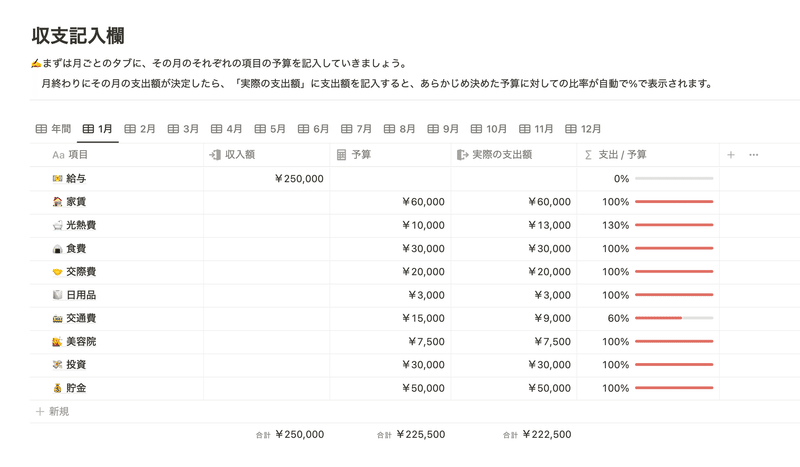
...For those messy people who thought, "Do I really have to keep receipts and calculate them?" Don't worry, I can't do that either. (Laughs)
For those who find recording each receipt troublesome, I highly recommend a method.
That is, to pre-divide payment methods such as cards and QR payments by item.
For example, food expenses are paid with PayPay, daily necessities with LinePay, and utility bills with a certain card. In fact, I also organize my payment methods by genre in this way.
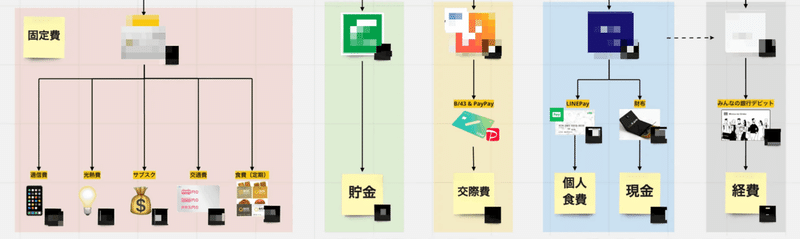
If you divide your payment methods in advance, then the monthly amount for each payment method will equal the expense for each category. That way, at the end of the month, you just need to refer to those amounts and input them!
This management method is highly recommended for messy people like me, so if you've found household budgeting too much trouble to keep up with before, please give it a try!
When you enter the expenses for each category, a graph will display the proportion of your actual expenses compared to the budget you set in advance.
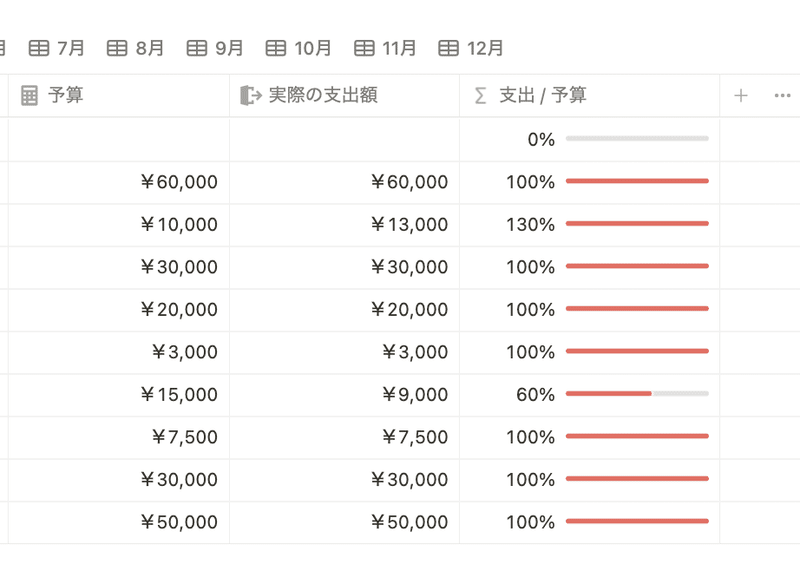
If you exceed 100% and find that you "spent more than I thought" on a certain item, try to be particularly careful with that item the next month.
Also, if there is a significant discrepancy from your budget, you might consider reviewing your budget starting next month.
3. Check your annual income and expenses.
As you enter your monthly expenses, the "Monthly Income and Expenses" table will automatically display the total income and expenses for each month.
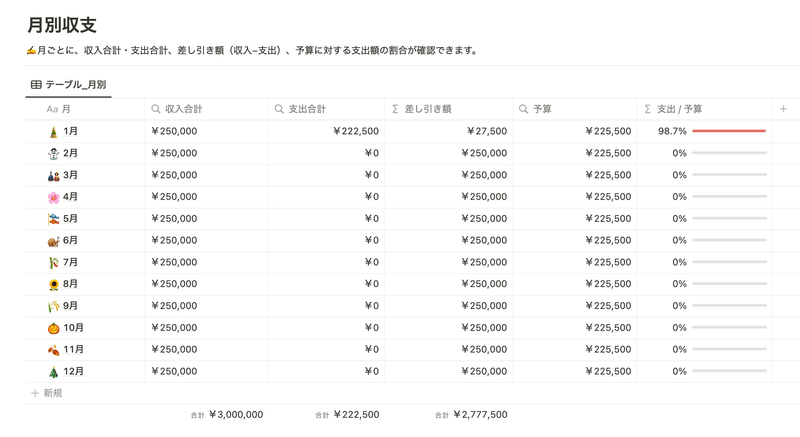
Notion automatically calculates the remaining amount (balance) after subtracting total expenses from total income, and even the ratio of actual expenses to the overall monthly budget (total of category budgets)!
This visualizes how much money you have left over each month or months when you've overspent, so you should be able to control your finances properly throughout the year!
Also, the annual total amount is displayed at the bottom, allowing you to grasp your financial movements over the year.
The convenience of using Notion.
Finally, let's review the benefits of keeping a household budget in Notion.
1. Even messy people can keep a household budget!
The image of "keeping a household budget" often involves keeping receipts and painstakingly calculating them, or taking a picture of each receipt, so it's often seen as something only diligent people can stick to.
However, by combining the method of pre-dividing payment methods that I introduced and this Notion household budget, you don't need to calculate receipts yourself or take pictures of them.
Doesn't that sound like something even a messy person could stick to?
2. Everything is calculated automatically.
While Notion has a simple appearance, it can surprisingly use formulas as extensively as Excel.
This page also automatically calculates monthly totals and provides the ratio of expenses to the budget. It even displays it in a graph.
Not having to calculate everything yourself every time is very easy, and it also prevents mistakes, so it's a win-win.
3. Create as many categories as you like.
One thing I found a bit inconvenient about household budget apps was the limit on categories. Many apps can solve this if you pay, but as I mentioned in the previous article, I don't want to increase my subscriptions too much. (Laughs)
Notion offers a high degree of freedom, allowing you to create as many categories as you like. And, of course, it's free no matter how many categories you create!
For example, you can freely create personal hobby categories like "gadgets" that aren't available in household budget apps, which is very convenient.
The ability to freely change icons is also a nice touch.
Summary
That concludes my introduction to how to keep a household budget in Notion! What did you think?
If you're having trouble sticking to a household budget, please give the method I introduced a try!
The ultimate task management template achieved with Notion, "Todotion," is available here!

The 2-hour "Notion Master Course" is now available, teaching you Notion from scratch through videos!

The book "Notion Lifehacks," which introduces 36 ways to use Notion, is also now on sale!