
Hello! I'm Rei, an official Notion ambassador.
This time, I'd like to introduce a method for university students to **manage their timetables and notes with Notion**!
To all university students, what tools do you use to manage your university timetables, notes, and so on?
Recently, I've been seeing more "Notion utilization tips for university students" on social media, so I imagine quite a few people are using Notion now.
That made me wonder, **if I were a university student now, what kind of Notion setup would I create...?** So, this time, I decided to create "**a Notion university page I'd want to use if I were a university student now**!"
I believe this content will resonate not only with current university students but also with working adults like me who wished they had Notion during their university days.
This time, I'll be explaining this template in detail, so please read until the end!
🎬 Director: Rei
✍🏻 Writer: Minokurumi
Why university students should use Notion.
When I was in university, Notion didn't even exist yet.
I checked my timetable on the university's portal site, which wasn't exactly user-friendly, and kept notes in Evernote. I didn't manage assignment deadlines in any particular place, so looking back, I wouldn't say it was an ideal environment.
Having gone through university and now working, with Notion widely available, I think, "**If I were a university student now, I would definitely live my university life with Notion...**" I'm almost envious of today's university students, actually. (laughs)
Here are some of the reasons I recommend Notion to university students:
📍**Reasons why I recommend Notion to university students**1. Timetable, assignment management, and notes, all in one place.
2. Digital notes are easy to share.
3. Can be reused semester after semester.
If there are any university students out there not yet using Notion, I want them to discover Notion as soon as possible! (laughs)
How to create a university page in Notion.
Now, I'll introduce the **detailed contents of the university page** that will be distributed this time, and **how I would utilize it if I were a university student.**
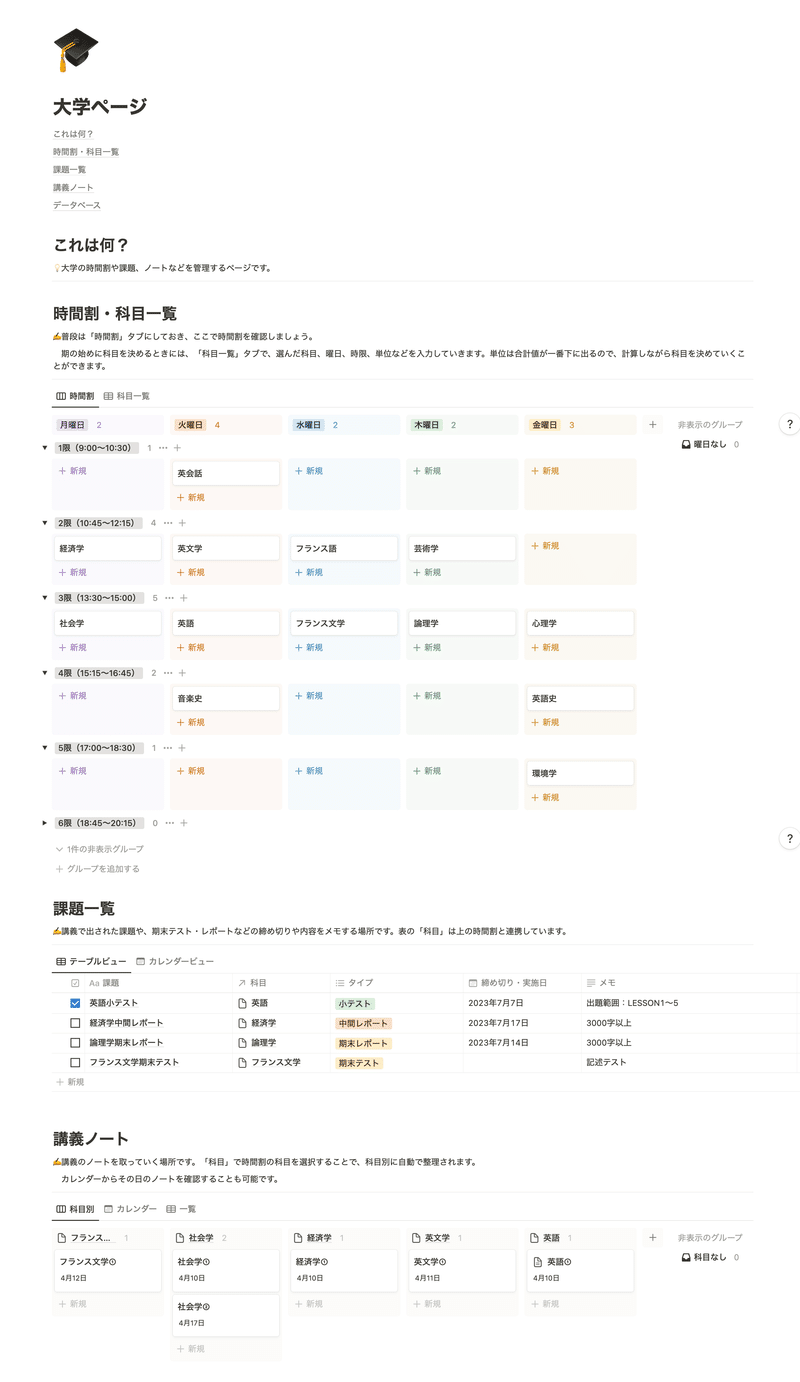
The page is **divided into three main blocks** as follows:
- **Timetable / Course List**
- **Assignment List**
- **Lecture Notes**
1. Decide on courses while calculating credits. An automatically generated "Timetable."
The first thing university students struggle with is **credits**. It's quite a difficult task to create a timetable while ensuring you earn the necessary credits.
In fact, when I first started university, I had no idea what "credits" were, and I diligently calculated my timetable while poring over the university's course catalog with a list of credits for each subject...
With Notion, such a demanding task can be made easy: you can **decide on courses while automatically calculating credits and automatically create a timetable table**!
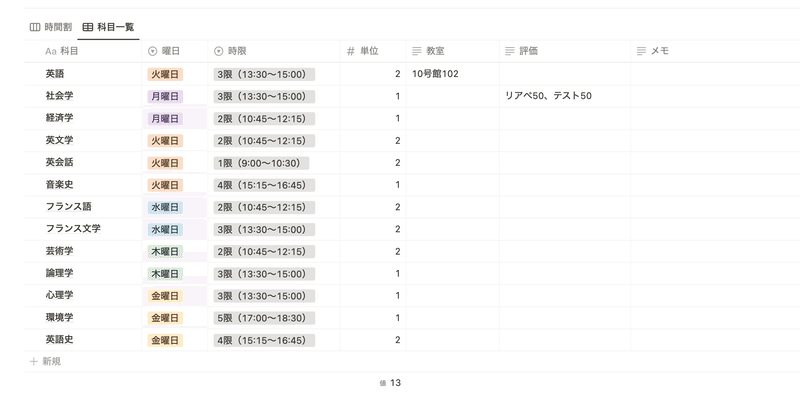
First, in the "**Course List**" tab, **list mandatory courses and any interesting courses**. Fill in the table items one by one.
The table items are:
- Day of the week
- Period (1st period, 2nd period...)
- Credits
- Classroom
- About evaluation
- Notes
The key point is that when you input the credits, **the total automatically appears at the bottom**. Look at this total and adjust your credits and desired courses, being careful not to have overlaps in days and periods.
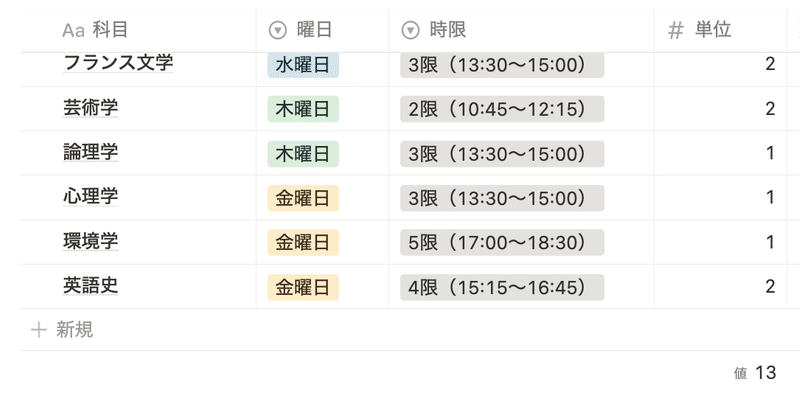
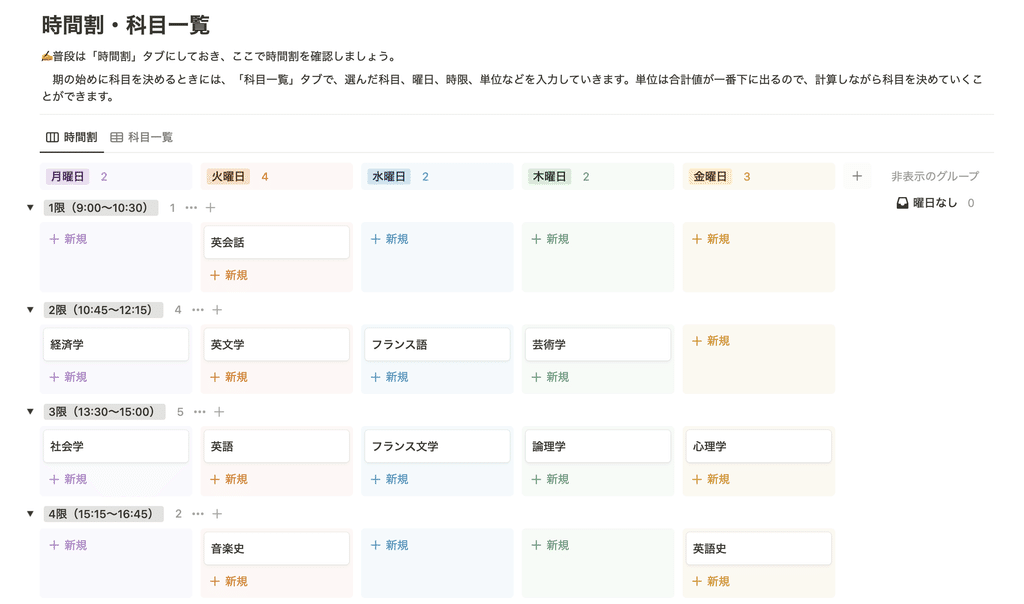
Once you've decided on the courses you want to take in the "Course List" tab, a timetable table like this will **automatically be completed in the "Timetable" tab**.
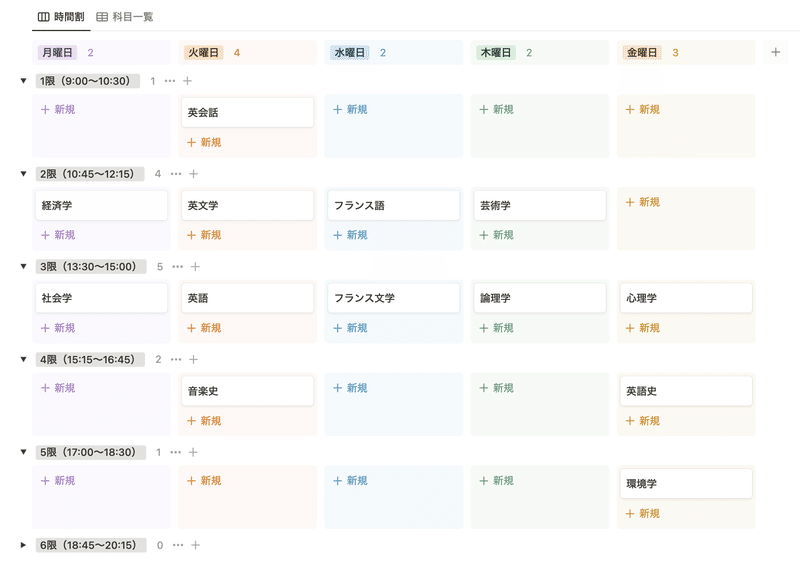
The horizontal axis represents the days of the week, and the vertical axis represents the periods. The color-coding makes it easy to see the days, and you can view your weekly schedule at a glance, so you should **check your timetable using this tab daily**.
2. Don't forget test dates or report deadlines with the "Assignment List."
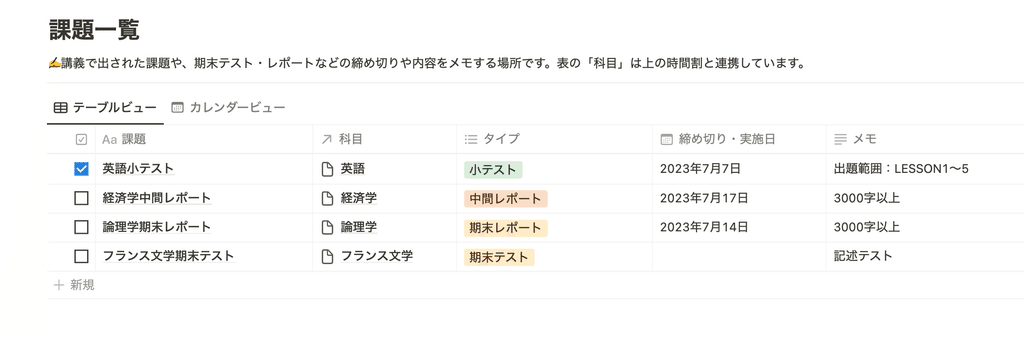
Big university events include final exams and final reports. However, there are also smaller assignments like quizzes and midterms, which can pile up.
Naturally, several lectures run in parallel at university, so it's easy to forget **assignment deadlines and scope**.
Therefore, if you **create a place to manage them beforehand**, taking notes and reviewing them later will be smooth.
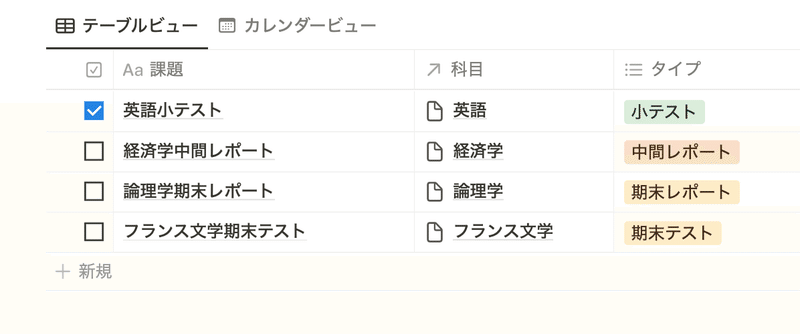
To use it, create a new assignment page and select the course. (You can select courses from the "Timetable / Course List" you created earlier.)
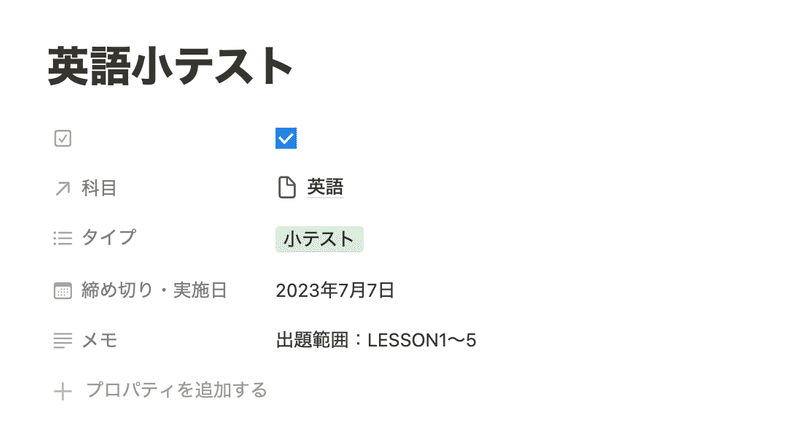
Next, select the assignment type (test, report, etc.) and enter the deadline/date. It's also convenient to write down the **scope** and **word count** in the memo field for easy reference.
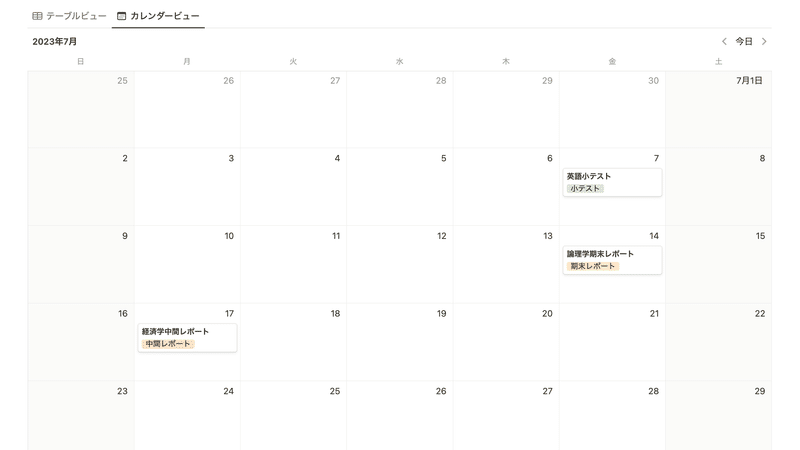
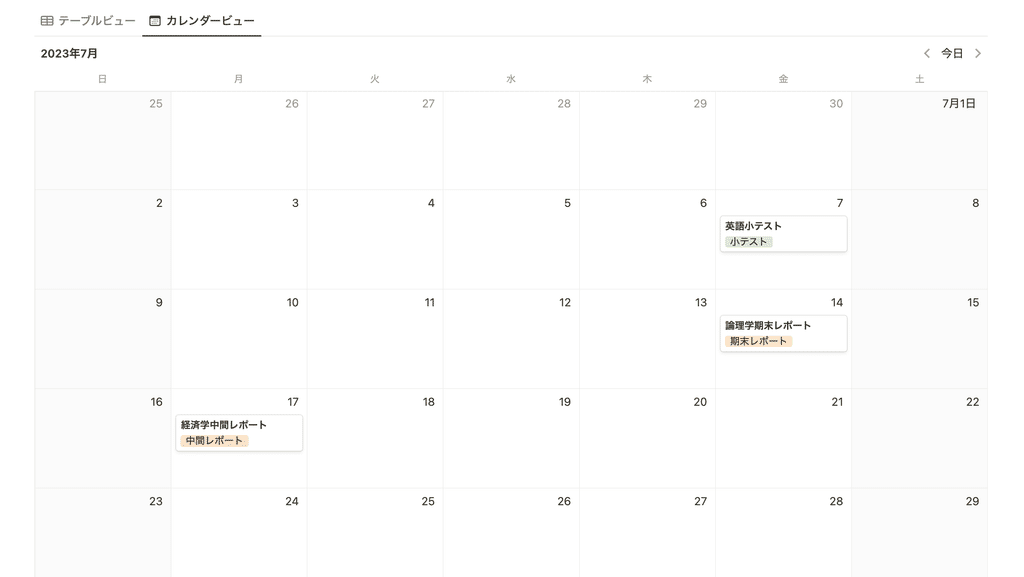
It also automatically reflects in the adjacent calendar tab, so you can **check assignments by date**.
3. Digital notes make you more agile.
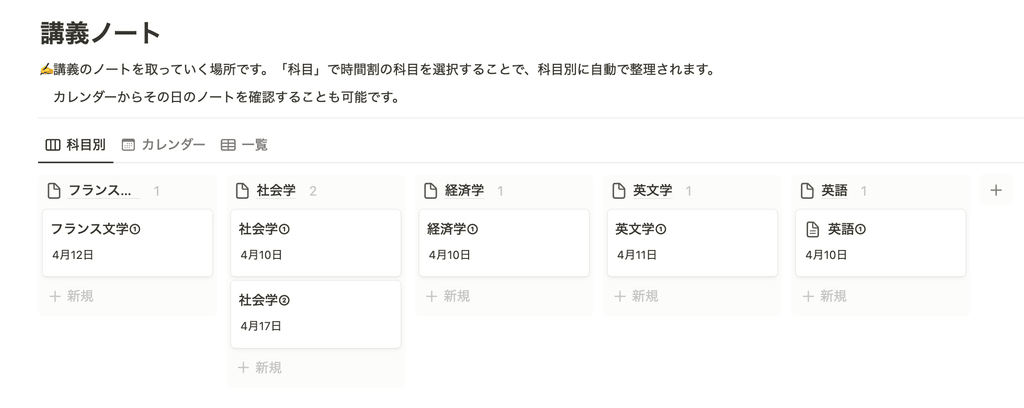
Paper notebooks tend to accumulate quickly when you separate them by subject and purpose. On days with many subjects, just carrying your notebooks can be exhausting.
If you switch to digital notes, you'll be much more agile, **carrying just a computer or tablet**.
Nowadays, many lectures are online, so the ability to **paste screenshots and materials from lectures** is another unique advantage of digital notes.
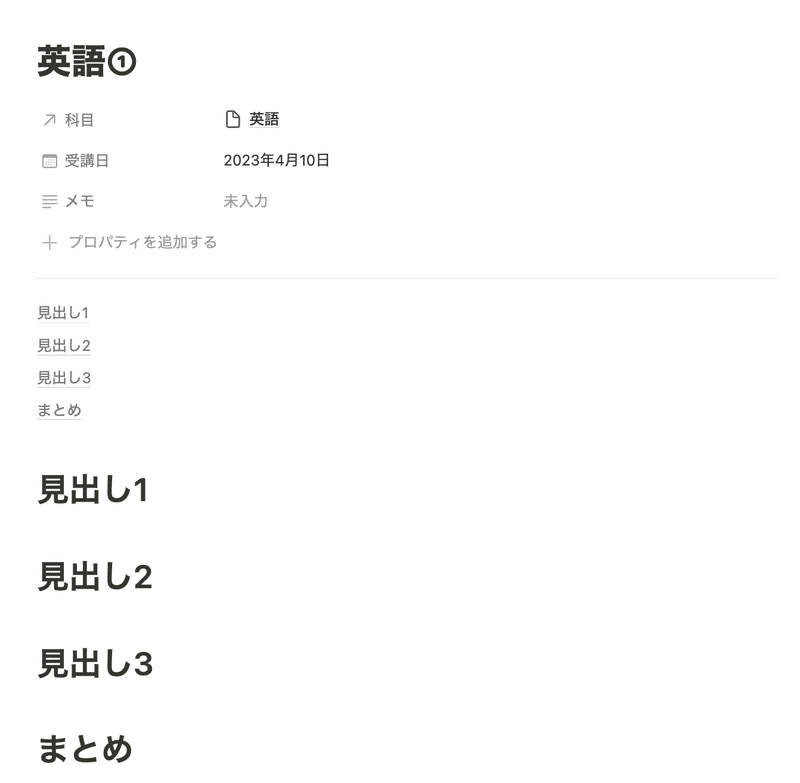
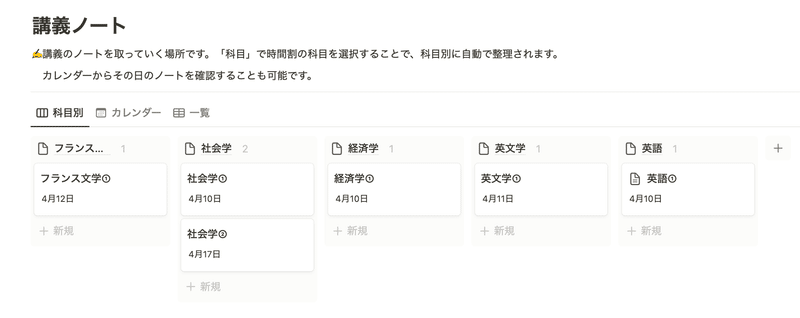
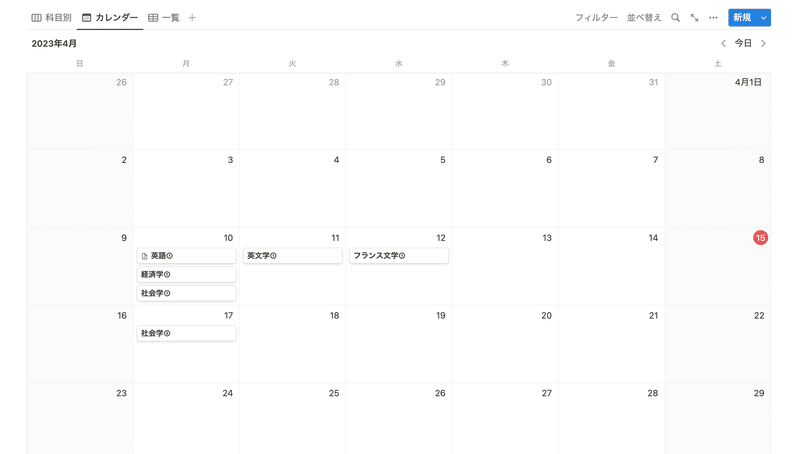
When taking notes, create a new page, select the course. After selecting the lecture date, simply take notes within the page.
The notes you create are **automatically organized by subject in the "By Subject" tab**. You can also **view notes created for each lecture date** in the "Calendar" tab. This makes it easy to find notes when you want to review them later.
Here's what makes it convenient if you use Notion.
Finally, let's reiterate the advantages of organizing all your university affairs in Notion.
1. Timetable, assignment management, and notes, all in one place.
When I was a university student, there wasn't a service like Notion that allowed you to freely consolidate everything, so I used various tools in parallel, such as the university portal site and Evernote.
However, after creating this page, I realized anew that **Notion can consolidate all tools into one**.
Consolidating everything into one place provides a sense of **security** that "you can find everything related to university here," and it becomes very **simple**.
By having a designated place for lecture notes and assignment notes beforehand, you can take notes without hesitation and easily find them later.
2. Digital notes are easy to share.
A common scene in school life is **borrowing and lending notes**. (laughs)
Even in my student days, I would lend notes or borrow them from friends, and we supported each other. (laughs)
With Notion, such borrowing and lending can be done **instantly, even remotely**. You can invite people to a page or generate a URL from the "Share" button in the top right corner.
(Off the record, I used to collaborate with friends on notes in Evernote during university, but you can do that with Notion too. (laughs))
3. Can be reused semester after semester.
University life often involves a lot of repetition each semester, such as "deciding on a timetable," "taking notes," and "taking final exams."
One of Notion's charms is that **once you create a university page that's easy for you to use, you can reuse it**.
After a semester ends, you can duplicate the page, which **saves the content from the previous semester** and allows you to **create timetables and notes using the same familiar method**.
Summary
That concludes the introduction to **how to manage your university timetable and notes with Notion**! How was it?
Notion is highly customizable, so I really encourage you to arrange the template and create your own unique university page!
University students, if you have any suggestions like "this would be easier to use," please let me know in the comments!
The ultimate task management template for Notion, "**Todotion**," is available here!

The two-hour "Notion Master Course," where you can learn Notion from scratch through videos, is now available!

The book "Notion Life Hacks," which introduces 36 ways to use Notion, is also now on sale!